
Boxes
#wrightwritesnow 112

The technical part
Looking up the word box today made me realise that I am not, as some have said, a walking dictionary — or a walking grammar book, for that matter. It also reminded me of one day long ago when I looked up the word up in that apparent misnomer called the Shorter Oxford Dictionary. Reading to the end of that headword took ages.
There is no way—unaided—I could come close to listing out all definitions or phrases using either of those two words. For all we know, I could be in a box, not knowing which way is up. But I do not care and, I daresay, that no one else does!
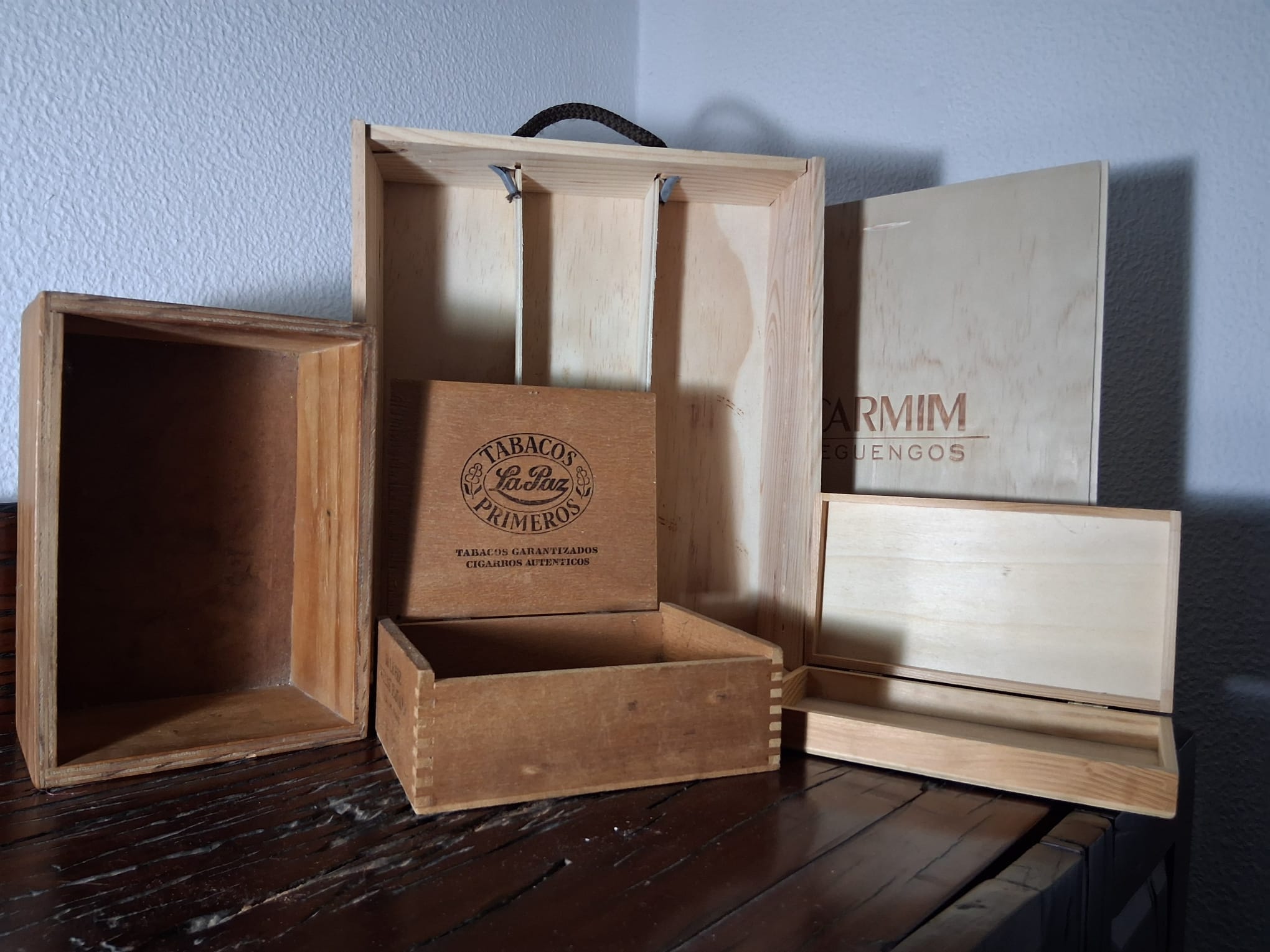
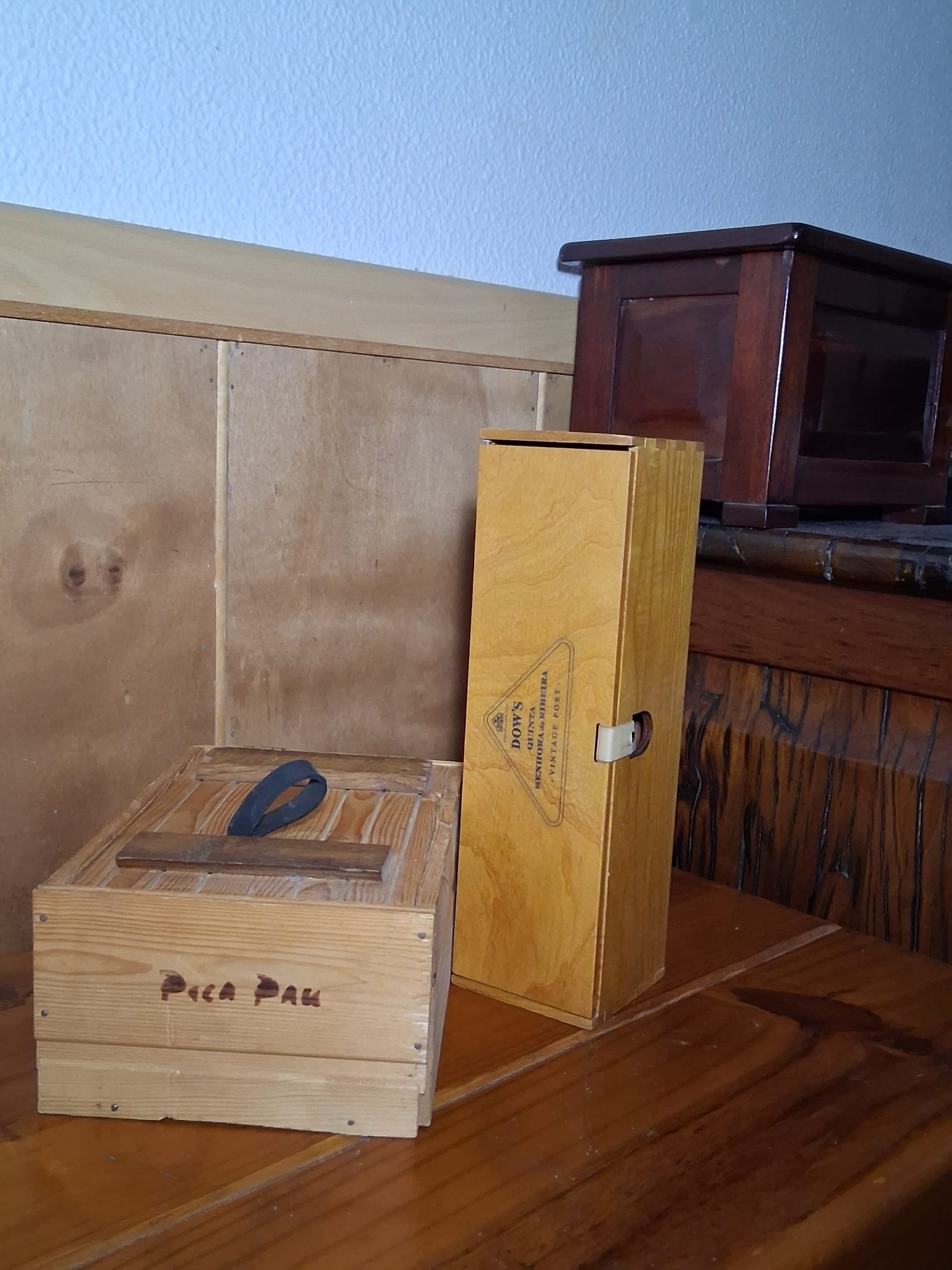
Before you start imagining that I am referring to crates or cardboard boxes of the corrugated, non-corrugated, laminated or unlaminated variety, let me be specific. I am focusing today on little boxes made of plywood.
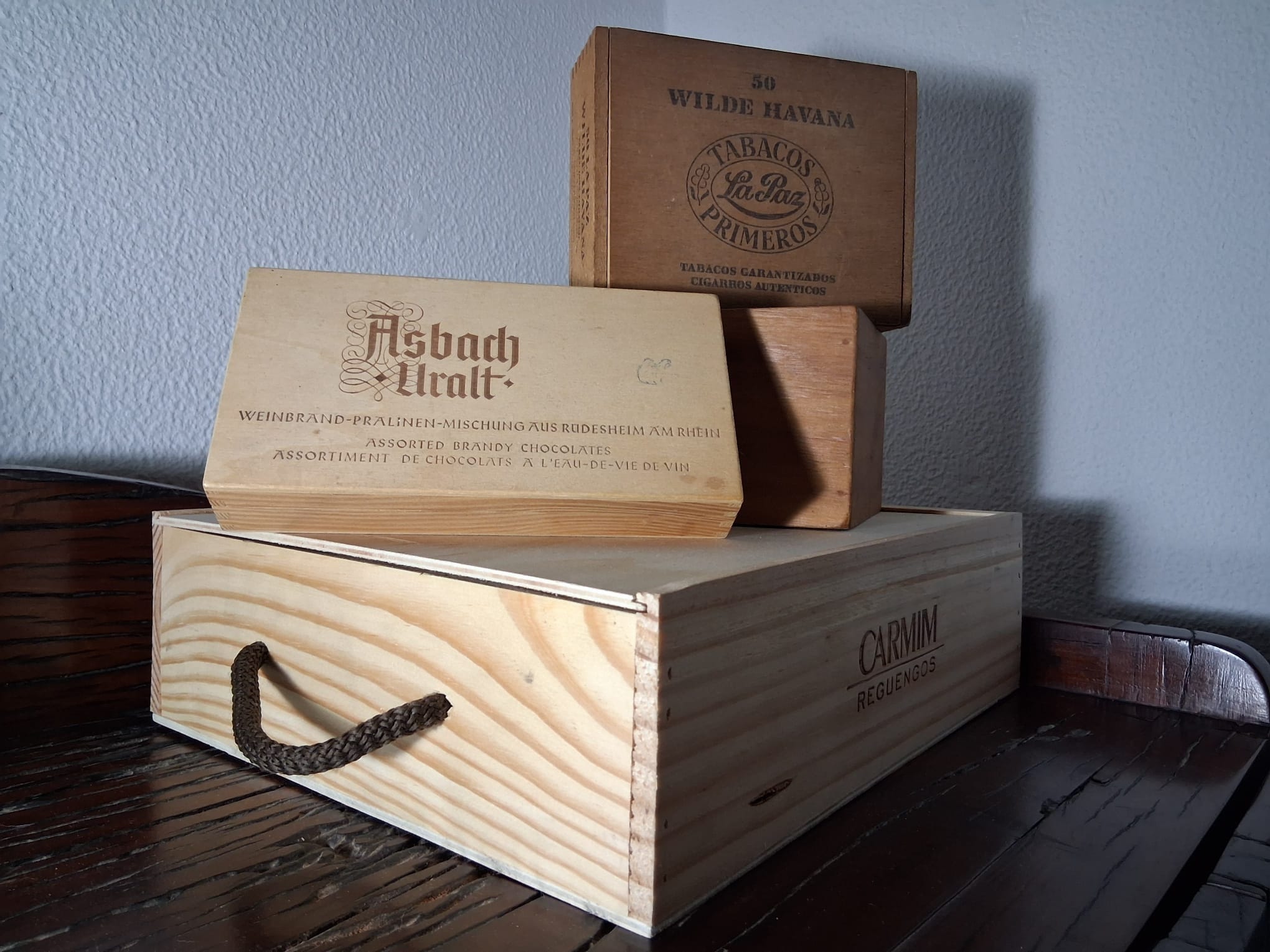
It turns out that the plywood of which I am so fond has been around for millennia, according to this delightful article by the Victoria and Albert Museum:
The link above is very interesting and has many images of moulded plywood. It is not mentioned in the article, but Bauhaus furniture made extensive use of moulded plywood, also called bent plywood, which lent itself very well to mass production, although the moulding process would be considered slow nowadays. I suppose that moulded plastic furniture took a few tips from the plywood professionals, but I am not going down that potentially enormous rabbit hole. You are welcome to go on your own journey in that regard!
I did a quick, minor digital deviation, however, which revealed that there is currently a resurgence of interest in moulded plywood as a low-energy, more environmentally friendly material. In a rock-paper-scissors game, I choose wood and wood composites over plastic any day of the week. It is mindblowing to me that over a century later, Bauhaus designs in terms of modernity and functionality have seldom been surpassed.
The personal, meandering part
In the practice of saying what one means and meaning what one says, I have long been sparing in the use of the words always and never. Yet, I think I can say with confidence that I have always loved little boxes made of plywood, at least since I first consciously laid eyes on them.
I must have been about eight when that happened. My maternal aunt was obliged to visit her mother-in-law for tea with her two young sons. The latter was a dour woman who conformed to the stereotypical worst living nightmare from which the most complex neuroses of daughters-in-law are woven.
The MIL wore knee-length skirts (and matching box jackets) of the type made fashionable in the 1960s by Jackie Kennedy. Yet for all her powder blue airs and graces and insistence on an idiosyncratic offshoot of Scottish Protestant propriety, the thin-lipped MHS (the MIL’s initials) never mastered the art of sitting like a lady (with her knees together, or with her legs or ankles crossed).
The view we were treated to was not as scandalous as my aunt or mother made out, since the meeting of her bestockinged upper thighs thankfully prevented further visual revelations. Yet the unspoken thought of what lay beyond this impediment hung like a dark cloud over every stilted conversation. The tension was as taut as the upper hem of MHS’s skirt, stretched as it was from knee to knee on legs that, once she was seated, never moved.
My aunt dreaded these visits, not only because of the preparation time involved in getting her four-year-old and two-year-old scrubbed up and pressed and dressed identically (as were my younger sister and I on this occasion, as was always the case a children — WTF was that all about?), hair carefully brushed and smelling of Nivea Creme, but also because she was likely to suffer long-term approbrium if even so much as a word of her conversation were out of place.
On that day, at least, my aunt had girded her moral high ground, with my mother in the passenger seat, and the four of us cousins in the back, already on our best behaviour, as she drove the half-hour journey across several Johannesburg suburbs to arrive at the MHS residence.
She talked all the way there. I was supposed to be too young to understand my aunt’s stories of the barbs, slights and downright nastiness inflicted upon her by the MIL. My mother handed her sister a tissue. She listened. She was also at pains to offer an alternative point of view, and careful advice on what to do in future situations. A scene I now know is almost as old as time itself.
The house, in the then genteel suburb of Rosebank, looked like so many others on that neatly paved and tree-lined road. It had a brick wall about a metre high, topped with about another metre of iron railings, painted black. The property itself was on a slight slope, so the enclosure from within the handkerchief of a garden was not that high at all. The four concrete steps from the pavement led to a pedestrian gate, also of wrought iron, which one pushed inwards to gain access to a short concrete pathway flanked by lush green lawn, newly and neatly mown, clipped on the edges that met the pathway and around each square flower bed, each home to a single, tall standard rose bush, set at geometric intervals on either side of the path.
The front door sat between two large bay windows, both heavily veiled by lace curtains that gave no clue as to the interior furnishings of each room, although my aunt said the one on the right was the sitting room, and said something about the windows always staying firmly shut and there being no air inside. She glanced briefly at the left bay window and rolled her eyes so that only my mother could see. This meant that behind those lace curtains was the main bedroom.
My aunt and my mother had their own secret eye language, perfected when, around the age of 21, my aunt suddenly became deaf for about a year and a half, after which her hearing gradually returned. She and my mother both learned to lip-read, and could have whole conversations with each other across crowded noisy rooms, if well lit. They had all sorts of other facial expressions that meant something, but only they knew what.
I became party to this historical medical information when I was about fifteen years old. I was fascinated to learn that even many years later, both my aunt and my mother used their lip-reading skills to eavesdrop, as it were, on conversations out of earshot at social gatherings, although always more out of curiosity than malicious intent, and often as a prelude to striking up a conversation with the person or people concerned.
When I was in my early twenties, I observed my mother practising this quiet art occasionally at the golf club, where she was the Lady Captain for a time. I have never mastered this particular skill, although one other talent my mother divulged to my sister and me when we were teenagers, that of reading documents upside down—on a table in a meeting, say—is something I took to like the proverbial duckling does to water. I was thrilled about ten years ago when I realised I could do this with Portuguese texts too, including some that are written by hand.
Reading things upside-down is a useful skill when negotiating, or in job interview situations (assuming your interlocutors are not hiding behind a laptop screen, or similar), yet one must always remember that the person or people sitting opposite you can probably also do the same thing. Hence the advantage to be had by conducting oneself without notes in such meetings, even if you have made copious notes and scribbled down endless points you wish to raise beforehand.
Anyway, so there we were, having rung the bell once, standing in front of MHS’s front door, waiting for it to be opened. This was the first and only time my sister and I ever went there, as far as I recall, although I think my parents went there for dinner on one occasion.
Greetings and an interminable three minutes of conversation ensued at the entrance once MHS opened the door, and stood there squarely at the threshold, blocking entry, as it were, before it finally occurred to her to invite the on-best-behaviour brigade to come in.
The dingy hallway—lit by a yellowy 40W bulb suspended from the ceiling, and shielded by the kind of scalloped cloth lampshades which I abhor, and did, even at that young age—smelled faintly of the wax polish used to achieve the high gloss on the dark parquet flooring throughout. It struck me that it was pretty pointless to shine the floors so, if one could not really see their brilliance properly. Yes, part of our best behaviour involved much wiping of shoes on the doormat before coming in. We had been briefed. And everyone’s posture was exemplary.
The airlessness of which my aunt had made mention was infused with the inimitable aroma which comes from cigars. Not so much from cigar smoke, but from the cigars themselves. Mr MHS was the cigar aficionado.
We were led in to the sitting room, which my mother would have described as a “lounge cum dining room” (cum being the Latin word for with, you understand). The sitting room section occupied the space that included the bay window, framed by a brocaded pelmet and ponderous curtains, the intercolumnal, as it were, stuffed with heavily pleated lace curtains which did indeed block most of the outside from view. Later, when we were seated, I spent a long time daydreaming while looking at the fine particles of dust dancing in the muted sunlight.
Behind the three-seater sofa which faced the bay window but acted as a divider between the sitting room and the dining space, there was a credenza, on top of which was displayed an assortment of cigar boxes, some of which—sealed—were stacked one upon the other.
Each box had exotic-looking pictures on the lid and sides, and words stamped straight onto the wood in a language I did not recognise, but now know to have been Spanish. The ornately decorated paper tape had been broken on three stand-alone boxes. The lids on two of them were not completely shut.
The adults were still standing, with their backs to us. MHS was droning on about an unremarkable painting on the wall, as our mother and aunt were obliged to survey the dining room appreciatively. Hmm. Hmmm. Gosh.
We children had our eyes fixed on the two partially open cigar boxes. My sister poked her finger in the gap of one and I did the same to the other. The aromatic delight that escaped as we did so was glorious — and brief. My mother sensed a shift in the air caused by her too quiet children. She turned. I beckoned her to bend down, so that I could whisper to her that one of the boxes only had one cigar left in it; couldn’t it be transferred to one of the other boxes so that we could take the box home?
You see, that was the rule: Mr MHS only ever gave away a cigar box when he had smoked all the cigars in it. My mother shook her head once and silenced me with her eyes. My sister and I assumed our good-girl pose, each with our hands neatly clasped together in front.
MHS had been interrupted. “Something wrong?” Her imperious tone did not faze my mother one bit. She coolly reported that I had just asked whether we could open one of the boxes and smell the cigars. MHS cranked her head up in agreement. “Don’t touch anything else, mind!” So we opened the box with more cigars in it, and inhaled deeply.
Before we could inhale a second time, MHS ushered us all into the sitting room, and rang the bell for the maid to bring the tea. From across the room, my mother bade my sister and I to sit up straight properly by straightening her own back ever so slightly.
As we did so, naturally, without fuss, both my aunt and my mother smiled at us, and we gave small, shy smiles back, and the social niceties began.
As I turned my eyes away from the feat of human engineering that was MHS’s skirt and towards the drifting particles of dust in the air between my aunt and my mother, I did not think I had asked for too much. It was just a box.
Quite right. It was just a box. It did not matter.
Oh, and since it is my birthday today, you might want to Buy Me a Coffee so that I can churn out more descriptions of a distant past. 1964, if you must know.
Or, you can skip the shelling out of euros, and simply leave a comment.
I have a wooden box with partitioned sections that are just the right size for reels of sewing thread. It has a sliding lid and I think I found it in the rubbish!
I love boxes such as you describe, and have a surprising number of wine cases that have been repurposed around the house as things like (small) shelves and occasional tables.
Happy Birthday!