Lunch with the family was finally over. Claire dutifully cleared the plates away, happy that the meal had been deemed satisfactory. She was also quite glad that she was not related to any of these people by blood, so different from her own kin. It was hard work keeping the conversation going with this lot, who mostly kept their thoughts to themselves, heads and shoulders bent over their food, shovelling it in as if it were so much sand into a cement mixer.
Except for Ana Margarida, who took Claire by the arm once the formalities were over and led her outside to the verandah, the apron to a generous patch of well-kept lawn.
“Sit here, next to me,” she said, as if Claire had not been seated right next to her throughout the meal.
Mario, her husband, now over 90, short-sighted and almost completely deaf, joined them. Mostly, he smiled affably and nodded occasionally when Ana Margarida demanded it.
The others came too. A general scraping of chairs ensued, but since none of them wanted to hear the story yet again, they sat a bit further away and busied themselves with lighting up cigarettes and finishing off their wine. And then endlessly saying the same thing to the dogs while patting them, and inanely holding the ball just out of their reach. So frustrating.
The view from the verandah was spectacular. It was as wide as the sky, with a valley dotted dark green with trees until it met the next range of hills, beyond which lay the sea. On a clear day, you could see patches of it here and there if you looked hard enough.
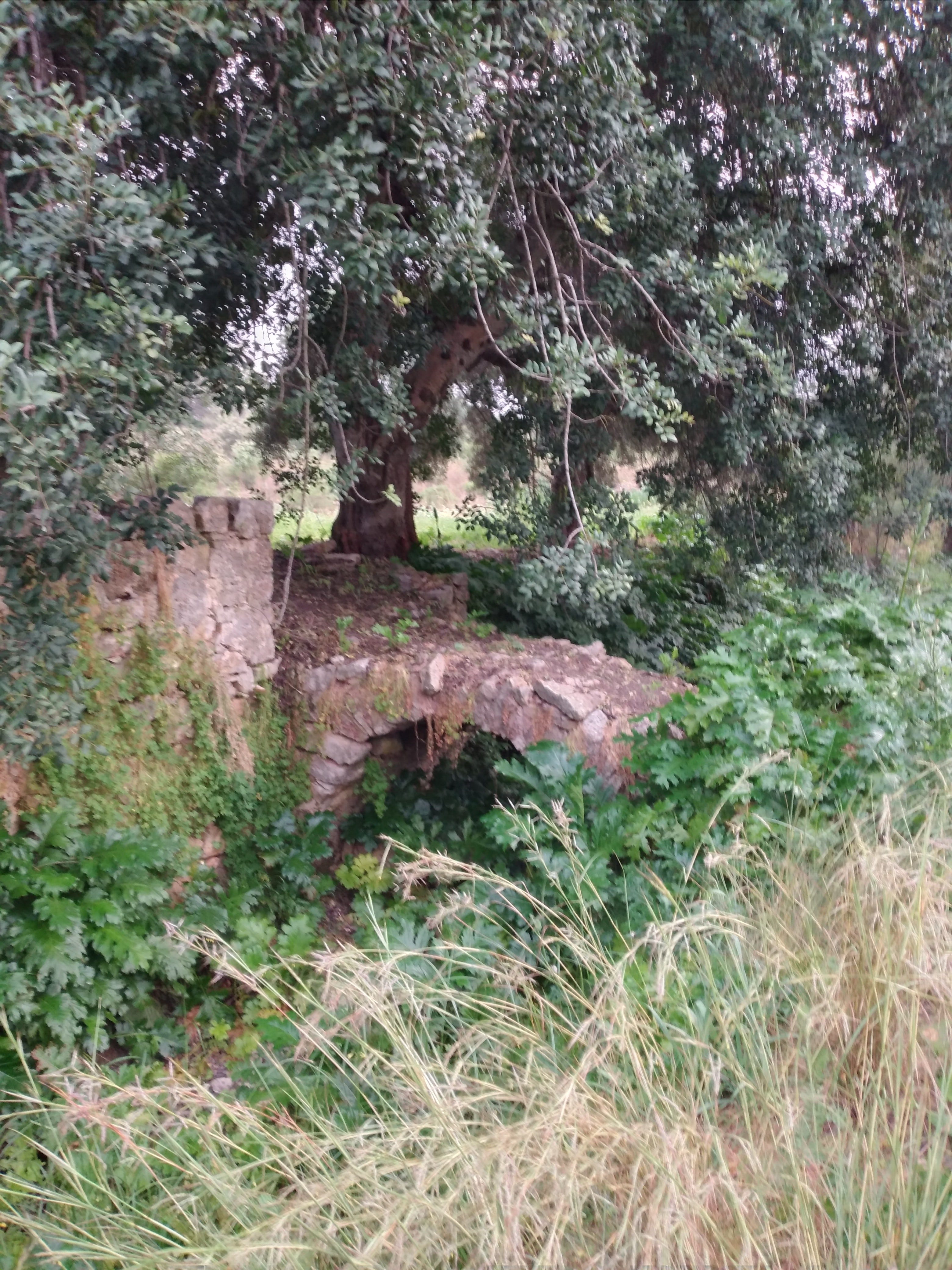
To the right of the verandah and a bit further along was an enormous carob tree. The trunk alone was almost a metre wide. Its shade was welcome. Even though the hottest part of summer was over, it was still too damn hot. Claire told Ana Margarida that she had picked most of the carobs that year.
“Look, fourteen sacks!” She pointed at them, stacked neatly against the drystone wall nearby, ready to take to the mill. As expected, her de facto mother-in-law did not think this was remarkable. To her, it was ordinary work that had to be done, nothing more.
“That is our tree, isn’t it, Mario?” She said it loudly again, and only then did he nod, grinning in a way that could be mistaken for shortness of breath, as he shifted in his seat.
“What do you mean?” asked Claire, even though she knew the answer, for this story was rolled out without fail at every high day and holiday lunch.
“My family lived here, when the house was very small, long before my son made it bigger, like it is now. I was born here. One summer, when I was old enough, I went to the dances in town. There were two. Mario asked me to dance at the first one.”
“I thought he lived far away from here, up in the hills.” said Claire.
“He did when he was younger, but in those days, he had a job at the cork factory, and lived closer. And he had a bicycle. After that dance, he used to visit me on Sundays after lunch. My mother did not like him. So he would hide his bicycle in the bushes further down the hill, and then come and stand behind the carob tree, and whistle like a blackbird. I would hear him and walk down to meet him, after washing the dishes.”
“Can you still make the sound of the blackbird, Mario?” Claire asked, teasing him. She had heard this story many times before.
“No, not any more,” he replied, smiling, as his dentures clacked against his shrunken gums.
Ana Margarida rolled her eyes, indicating her now habitual impatience with him.
Originally, the house on the hillside was very small, built of stone. Now it was new, modern and much bigger. The old house in its entirety was about the same size as two of the rooms in the new house. That was where Ana Margarida and her siblings had lived with her parents. They had lots of land, back then, but sold it later when hard times came. It was a complicated and vague story. Claire had heard it only once and had forgotten the detail.
“Why did your mother not like him?” Claire asked, hoping for the real answer this time. As usual, Ana Margarida shrugged, as if water under the bridge were a soothing balm for hurts felt so very long ago. She never did say why.
“She didn’t want me to go to that second dance with him, in the middle of summer. But we had arranged to meet there, so effectively I did attend the dance with him. Word got back to my mother in the days that followed. It must have, for she was less pleased with me than usual. I always had to read between the lines with her, you know, so I just kept quiet and got on with my chores.
“Not long after that, I began to feel sick. I vomited and vomited every morning—you know. One day, my mother said it was high time she took me to the doctor. We walked down to the town the very next day, even though it cost money to see the doctor. My mother was cross, but not so much about the money. She still would not speak to me.”
Ana Margarida skipped over the detail of the doctor’s medical examination with a dismissive wave of her hand in a loose figure of eight, pausing for a long while and staring at Claire intently to see if she had got her meaning, which, of course, she had. When she had finished remembering everything she did not say, or would not say, she continued.
“Afterwards, we sat on two wooden chairs in front of the desk in the doctor’s office. He did not look at me. Instead, he turned to my mother and said, "‘Do you know, Mrs Martins, that your daughter is pregnant? Did you already know?’”
Ana Margarida’s eyes went wide as she landed on her punchline, mimicking the shock that she must have felt at the time. The shame and scandal of it all! This part of the story never changed, no matter how many times she told it to Claire.
She shot a resentful glance in Mario’s direction, but he was benevolently gazing into the middle distance through his thick, smudged spectacles.
“What did your mother say to the doctor?” asked Claire.
“She said it was what she had thought, and thanked the doctor for his time. We left quickly after that. We still had dirt roads around here, and the heat and the dust made it hard for me to keep up with my mother, who was speeding ahead, furious. When we got as far as the house belonging to my uncle, my mother told me to walk on home and start preparing lunch because she needed to stop there and phone her sister in Setúbal.
“When she got back home, she said I should thank God that she had a sister who had married well, and that I should send a message to the father of the child in my belly to present himself here as soon as his shift finished on Saturday. I would be spending my confinement in Setúbal, no arguments about that.”
Before they knew it, Ana Margarida and Mario were on the train, on their way to Setúbal to her aunt and uncle’s enormous home. They stayed in basic quarters at the back of the mansion. Her uncle got Mario a job at his canning factory. Mario was under strict instructions to save money for when the baby came, to look after his new family.
“My aunt kept me with her,” said Ana Margarida.
Claire always felt slightly annoyed about that lack of detail in this part of the story, but since Ana Margarida relied on a hearing aid, any questions had to be belted out in a loudspeaker voice, making a true tête-à-tête on women’s matters impossible.
“Yes, but what did you do—what work did you do—during this time?” Claire asked.
At that, Ana Margarida’s grandson looked up from his phone, suddenly interested in the story. No one had ever asked that question.
“I helped with cleaning and cooking, and washed clothes. So much laundry!” was the reply.
“That couldn’t have been easy as the months went by and you got heavier,” Claire remarked, arching an eyebrow towards the grandson, whose expression softened in understanding for an instant.
Ana Margarida nodded. “It was a lot. My aunt was kind, though.
“Then it was time for us to come back.”
“What—before you had the baby?” asked Claire. In her mind, the whole idea was to give birth away from home, only to return later, when people’s memories had faded, and nobody really cared.
“Yes, it got a bit complicated,” said Ana Margarida, looking up briefly at the oblivious Mario, and then down for a while at her arthritic fingers placed in front of her on the table as flat as they would go.
Another silence ripe for the gathering of conjecture. Mario’s walking stick clattered to the floor. Claire leaned over, picked it up and righted it. She asked the grandson to go inside and put the kettle on, and bring out herb tea for her and Ana Margarida.
“By that time, my mother had arranged for us to live in that cottage over there, at the end of the lane. That’s where I gave birth to my daughter. Yes, in that cottage, where the woman with all the cats lives now. And the next year, your partner was born.”
“Hang on,” said Claire, doing a sum in her head, “so that means you were almost seventeen when you had your daughter. And how old was Mario?”
“Twenty-seven. That’s how it was.”
Ana Margarida sighed almost imperceptibly, and took a sip of her tea. She gave Claire another one of her meaningful looks.
“Do you see? That’s how it was. That’s life.”
Claire held her gaze, and nodded. “Yes. Yes, I do. Let’s go for a walk.”
Amid the general bustle as everyone got up from their chair, she received looks of gratitude from the others. The walk would mean that, this time at least, they would not have to endure the long and involved story about how the matriarch had managed to secure a pension for couple’s old age, and other uncomfortable truths.
The dogs ran ahead along the shady lane towards the cat lady’s cottage and disappeared into the field beyond. The others strode ahead, and the old couple traipsed behind, each with a stick, taking in with a certain wonder and a certain melancholy how some things change, and some things stay the same.
Claire hung back, suddenly missing her own—very different—mother, half a world away.
©2026 Allison Wright